


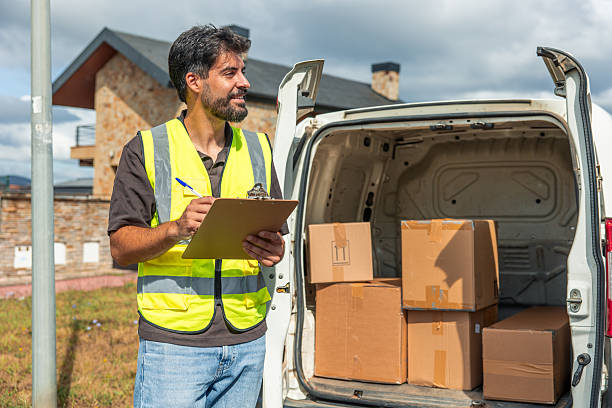
Last-mile micro-fulfillment in Lagos is a logistics model where fast-moving products are stored in smaller fulfillment hubs positioned close to customers. Instead of sending every order from one large warehouse across the city, businesses can keep popular products closer to the areas where orders are concentrated.
This approach can help e-commerce businesses reduce delivery distances, respond to orders faster and manage Lagos traffic more effectively. Micro-fulfillment centres are generally compact urban facilities designed to hold inventory closer to customers rather than relying entirely on large warehouses located farther from residential demand. (DHL)
How Last-Mile Micro-Fulfillment Works in Lagos
A typical operation follows a simple flow:
- Products arrive at the main warehouse or supplier.
- Fast-moving SKUs are identified from order data.
- Selected inventory is moved to a smaller Lagos micro-fulfillment hub.
- Customer orders are received through the online store or marketplace.
- Staff pick and pack the orders.
- Orders are grouped by delivery zones.
- Dispatch riders or delivery vehicles collect the packages.
- Orders are delivered to customers within the surrounding areas.
The idea is not necessarily to move your entire inventory into several small locations. Instead, businesses can position their most frequently ordered products closer to customers while keeping slower-moving stock in a larger central warehouse.
Where to Locate a Micro-Fulfillment Hub in Lagos
Location is one of the most important decisions when setting up a micro-fulfillment operation.
Ikeja and Oregun
Ikeja and Oregun can work well for businesses serving large parts of the Mainland. The area provides access to several important commercial and residential corridors and can be useful for businesses receiving stock through Lagos transport and airport-related logistics networks.
Yaba and Surulere
These areas can be useful for businesses serving customers around Mainland Central Lagos, especially social-commerce brands, online retailers and businesses with frequent smaller deliveries.
Lekki, Ajah and Sangotedo
For businesses with strong demand on the Island and Lekki corridor, having inventory closer to these customers can reduce the distance between the fulfillment point and delivery destination.
Apapa and Mile 2
These areas can be more appropriate where imported inventory enters Lagos through the port corridor before being redistributed to other fulfillment locations.
The right location ultimately depends on where your customers are concentrated, where your suppliers are located and how many orders you dispatch each day.
What Products Should Go Into a Micro-Fulfillment Hub?
Micro-fulfillment works best when the available space is used for products that move frequently.
For example, an online fashion retailer could place its most popular clothing sizes and colours in the local hub while keeping less popular products at its main warehouse.
Other suitable products may include:
- Beauty and skincare products
- Phone accessories
- Small electronics
- Fashion accessories
- Household items
- Packaged food
- FMCG products
- Frequently purchased spare parts
- Small e-commerce products
Heavy, slow-moving or rarely ordered products may be better kept at a larger central warehouse unless there is a specific reason to position them locally.
Micro-Fulfillment vs a Normal Warehouse
A traditional warehouse is primarily designed for larger-scale storage and inventory management.
A micro-fulfillment hub is designed around speed and proximity to customers.
For example, an online retailer could keep 80% of its inventory in a central warehouse while moving its fastest-selling 20% into smaller hubs serving high-demand areas.
This creates a two-level system:
Central warehouse: bulk storage and wider inventory.
Micro-fulfillment hub: fast-moving inventory and rapid local dispatch.
This can be particularly useful when customer orders are spread across different parts of Lagos.
Why Lagos Traffic Makes Hub Location Important
A delivery that looks short on a map can still take much longer because of traffic, road conditions, peak-hour congestion, loading delays and customer availability.
This is why micro-fulfillment is not simply about finding cheap warehouse space. The facility needs to be positioned according to actual customer demand.
If most of your orders come from Lekki and Ajah, storing your fastest-moving products far away on the Mainland may create unnecessary delivery mileage. Similarly, a business with mostly Mainland customers may not benefit from putting its primary micro-hub deep into the Island.
What a Good Micro-Fulfillment Facility Should Have
A suitable facility should support quick inventory movement rather than simply providing empty storage space.
Look for:
- Easy rider and van access
- Secure entrances
- Shelving for SKU organization
- Reliable electricity
- Backup power where required
- CCTV and access control
- Good internet connectivity
- Packing tables
- Dispatch staging space
- Clear receiving and returns areas
- Adequate ventilation
- Protection against water intrusion
- Space for temporary holding of outgoing orders
For businesses handling food, cosmetics, pharmaceuticals or other sensitive products, additional storage and handling requirements may apply.
Order Picking and Packing Matter
A micro-fulfillment hub can be close to customers and still perform badly if workers spend too much time looking for products.
Products should be arranged according to sales frequency and SKU structure.
Fast-moving products can be placed closer to the packing and dispatch area, while slower-moving inventory can occupy less accessible storage positions.
Barcode scanning, inventory software and proper stock counts can also reduce picking errors.
Connecting the Hub to Last-Mile Delivery
The micro-fulfillment centre should operate as part of the delivery system rather than as an isolated warehouse.
Once an order is packed, it should move quickly into dispatch.
Orders can be grouped according to zones such as:
- Ikeja
- Yaba
- Surulere
- Victoria Island
- Lekki
- Ajah
- Sangotedo
- Mainland corridors
- Other areas covered by the delivery network
Businesses can then assign the appropriate dispatch option depending on parcel size, delivery urgency and destination.
Some Lagos fulfillment operators already combine warehousing, order processing and last-mile delivery, allowing inventory to move directly from storage into local delivery operations. (MFT Fulfillment Centre)
Same-Day Delivery From Micro-Fulfillment Hubs
Micro-fulfillment can support same-day delivery because inventory is already positioned close to the customer.
However, businesses should avoid promising same-day delivery everywhere in Lagos simply because they have a local hub.
The actual service level depends on:
- Order cut-off time
- Customer location
- Traffic conditions
- Rider availability
- Product availability
- Packing speed
- Weather
- Delivery address accuracy
A realistic delivery promise is better than advertising an extremely fast service that the operation cannot consistently achieve.
Managing Returns From Lagos Customers
Returns should be included in the fulfillment design from the beginning.
A returned product may need to be:
- Collected from the customer
- Returned to the appropriate hub
- Inspected
- Separated from damaged goods
- Restocked if suitable
- Sent back to the main warehouse if necessary
Without a proper returns process, a micro-fulfillment operation can gradually accumulate unverified stock and create inventory discrepancies.
How Much Space Do You Need?
The required space depends on order volume, SKU count and product dimensions.
A small social-commerce business may only require a compact facility for a limited number of fast-moving products.
A larger e-commerce operation may require several hundred square metres or multiple hubs serving different demand zones.
Do not choose a facility based solely on square metres. Consider how many orders can actually be received, picked, packed and dispatched from the space each day.
Security and Inventory Control
Micro-fulfillment hubs can contain high-value inventory in relatively small spaces, making security important.
Businesses should consider:
- CCTV
- Controlled access
- Inventory counts
- Staff authorization
- Delivery documentation
- Stock reconciliation
- Proof of dispatch
- Proof of delivery
- Returns documentation
Every item entering and leaving the hub should be traceable.
Tribal and Cultural Considerations in Lagos
Lagos is highly diverse, with customers, employees, suppliers and delivery personnel from many ethnic and cultural backgrounds.
A micro-fulfillment operation should therefore focus on professional procedures rather than assumptions about particular communities.
Use clear customer addresses, recognizable landmarks where appropriate, respectful communication and proper delivery instructions. For businesses operating around markets or densely populated neighbourhoods, understanding local operating patterns can also help with loading, parking and customer handovers.
When Does Micro-Fulfillment Make Sense?
It becomes more useful when a business has:
- High order frequency
- Concentrated customer demand
- Fast-moving products
- Frequent same-day or next-day orders
- A need to reduce delivery distances
- Multiple customer clusters across Lagos
- Growing fulfillment workload
If you only receive a few orders each week, operating several hubs may add unnecessary storage and staffing costs.
Using Travo.ng for Last-Mile Fulfillment
Travo.ng can support businesses that need practical logistics coordination around inventory movement, fulfillment, delivery and last-mile operations.
Instead of treating warehousing and delivery as completely separate activities, businesses can coordinate the movement of goods from storage through order processing and onward delivery to customers.
For an e-commerce business expanding across Lagos, this can make it easier to plan inventory positioning, dispatch requirements and customer deliveries as order volumes increase.
Questions to Ask Before Setting Up a Lagos Micro-Fulfillment Hub
Before signing a warehouse agreement, ask:
- Where do most of our customers live?
- Which products sell fastest?
- How many orders do we process daily?
- What percentage requires same-day delivery?
- Can riders access the facility easily?
- How quickly can staff pick and pack orders?
- Is there reliable power?
- How secure is the facility?
- How will returns be handled?
- Can the space expand during peak seasons?
- How will inventory move between the central warehouse and local hub?
A successful micro-fulfillment operation is ultimately about placing the right inventory in the right location and connecting it to an efficient last-mile delivery system.
