
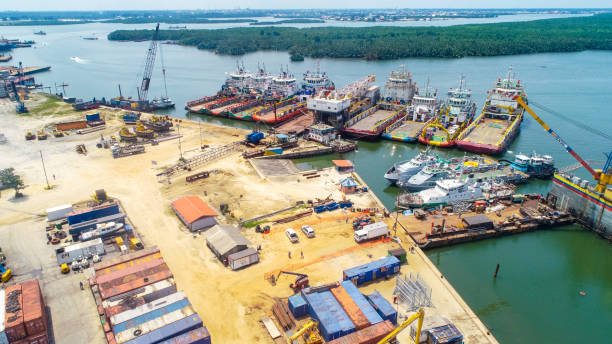
Landing craft hire in Lagos is a project enquiry, not simply a request for a boat by the day. Start with what must move, its dimensions and weight, the pickup and landing locations, and the handling method. A landing craft, a deck barge and a floating-crane arrangement serve different tasks. The right choice depends on the load, water access and the approved operating plan.
Landing craft, construction barge or floating crane?
| Service enquiry | Potential purpose | What needs assessment |
|---|---|---|
| Landing craft services | Moving suitable equipment or vehicles where the proposed craft and landing arrangement permit it. | Ramp arrangement, load geometry, access, deck loading and landing conditions. |
| Construction barge hire | Moving or supporting project cargo and equipment on the water. | Deck area, load distribution, securing, station keeping and transfer method. |
| Floating crane barge | A separately planned lift involving waterborne lifting equipment. | Lift geometry, rated configuration, rigging, landing area and competent lifting supervision. |
| Marine equipment transport | Moving plant, components or project materials between sites. | Full dimensions and weight, handling points, vessel configuration and destination readiness. |
These are ways to describe the requirement, not confirmation that a particular craft is available or suitable. A floating crane is not automatically included in barge hire, and the maximum figure in a crane’s name is not a verified lifting capacity at your required reach. Ask the specialist team to identify the actual equipment and its approved scope.
Prepare a cargo and equipment brief
List each item separately with a reliable weight, dimensions, quantity and any handling or transport restrictions. Provide drawings or appropriate technical information through the agreed business channel. Identify whether the item is wheeled, tracked, crated or loose, and whether the proposed transfer involves rolling, lifting or another method. Do not rely on an estimated weight when the operator requires verified data.
Tell the provider about attachments, fragile parts, fluids or other relevant hazards. Confirm who prepares the equipment for transport and who is responsible for securing, loading and unloading. If a vehicle must move under its own power at either end, discuss the actual operating and access requirements with the project team rather than assuming a ramp makes the job straightforward.
Assess both landing points before selecting the vessel
Identify the exact jetty, berth, ramp or work site and the person authorised to confirm access. Describe available handling equipment, working hours, road access and the planned receiving area. A map pin alone does not establish whether the vessel can reach the location, whether a load can pass the approach or whether the site can support the transfer.
Ask the marine operator and terminal or site team to resolve the operating window, water conditions, access restrictions and any survey or inspection needed. Do not assume a passenger jetty accepts heavy plant or that every waterfront can be used as an unloading point. Include the journey onward from the landing point in the logistics plan.
Floating-crane and heavy-lift enquiries
A useful floating-crane enquiry identifies the load, pickup and set-down points, required reach, obstruction information and the proposed operating environment. The responsible specialists need to assess the actual configuration and lift plan. Clarify who supplies the crane, barge, tug or support craft, rigging team, supervision and any required verification.
Record who approves technical changes. If the load, lifting point, landing position or operating conditions change, refer the change to the responsible team before work proceeds. A transport coordinator should not substitute an informal calculation for a competent lifting assessment. This guide does not offer an online tonnage calculator or certify a proposed lift.
Towage, support vessels and port coordination
Some project movements need towage or additional marine support. Give the operator the complete movement and operating area so it can assess the required resources. Read our Lagos tug and marine towing guide for the information needed for that separate service. If the project involves crew or supply movements, review crew boats and offshore support.
Within port or controlled areas, coordinate with the appropriate port, terminal and competent authorities through the responsible operator or agent. The Nigerian Ports Authority’s operational FAQ is a starting point for port procedures; the actual project permissions and operating conditions still need confirmation. Do not treat a commercial vessel quote as an authority to start work.
Price the whole project movement
| Quotation item | Question to resolve |
|---|---|
| Vessel and equipment | Which actual craft, configuration and equipment are included? |
| Positioning and time | Are mobilisation, transit, standby, waiting and demobilisation included? |
| Handling and technical scope | Who provides lifting, loading, securing and professional supervision? |
| Terminal and access | Which jetty, berth, access or terminal charges are separate? |
| Support craft | Are towage, work boats or crew transfers included? |
| Changes and risk | What are the delay, cancellation, insurance and incident-reporting terms? |
Compare quotations on the same scope. A low daily barge rate can exclude most of a complex project. Establish the operating window, quote validity and responsibilities in writing before committing. Related road haulage should be specified separately, including the final receiving address and unloading arrangement.
Open the landing craft and project barge checklist
Ask Travo about landing craft or project marine logistics in Lagos
We can discuss landing craft, construction barge, equipment-movement and floating-crane project enquiries and clarify the specialist support required. Supply the cargo information and locations so the proposed arrangement can be assessed before a quote is accepted. Send Travo your Lagos marine enquiry with both locations, date, passengers or cargo, access requirements and the service needed. We offer marine travel and logistics enquiry coordination in Lagos. The actual operator, vessel, approved scope, availability and written price will be confirmed before booking.
Explore Travo’s service catalogue for related road transport, cargo handling, travel and logistics support.
For broader cargo planning, use barge services and cargo movement and marine logistics in Lagos and Nigeria.
Reviewed 20 October 2026. Vessel availability, route, permissions, berth access, operating conditions and the complete quotation must be confirmed for the actual job.
Before finalising the landing point, use the Lagos jetty access and dock-transfer guide to define facility access, handling responsibility and the onward road connection. Those items should be explicit in the project quotation.
