


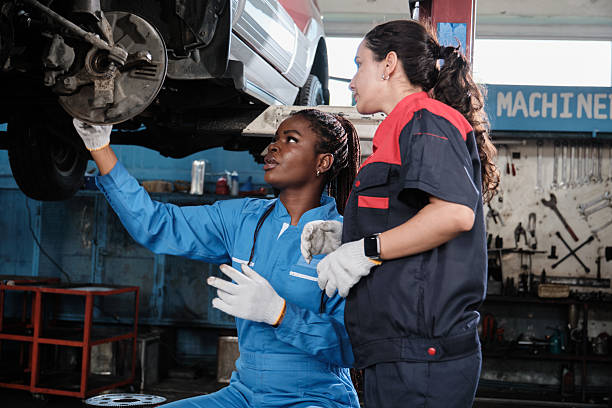
For people searching for technical college mechanic jobs, the route into employment is often more practical than simply getting a certificate and waiting for vacancies.
Technical colleges can provide training in automobile mechanics, mechanical maintenance, auto electrical work and other trades that are useful across Nigeria’s transport, manufacturing, construction and logistics industries. The key is to combine your technical qualification with real workshop experience and the ability to diagnose problems correctly.
Current Lagos vacancies show that employers are still hiring mechanics and mechanical technicians. For example, a current automobile mechanic vacancy in Amuwo requires technical training, apprenticeship or certification alongside practical experience, while a mechanical technician vacancy in Ikorodu advertises ₦250,000–₦350,000 monthly for candidates with relevant technical qualifications and experience. (Indeed)
What can you do after technical college mechanic training?
A technical college qualification can open several different career paths.
You can apply for positions such as:
- Automobile Mechanic
- Mechanical Technician
- Maintenance Technician
- Workshop Technician
- Auto Electrical Technician
- Fleet Maintenance Technician
- Heavy Equipment Mechanic
- Diesel Mechanic
- Generator Mechanic
- Field Service Technician
- Equipment Maintenance Technician
You do not have to remain in a traditional roadside workshop. With experience, you can move into factories, transport companies, logistics businesses, construction companies, equipment dealers and other organisations with large mechanical operations.
What employers expect from technical college graduates
The biggest advantage of technical college training is supposed to be practical ability.
Employers want someone who can actually work on equipment or vehicles, not someone who only understands mechanical terms from a classroom.
Useful skills include:
- Engine servicing
- Brake and suspension repairs
- Transmission maintenance
- Vehicle diagnostics
- Electrical troubleshooting
- Preventive maintenance
- Diesel engine repairs
- Hydraulic systems
- Pneumatic systems
- Equipment inspection
- Workshop safety
- Use of mechanical and diagnostic tools
For example, a current mechanical technician vacancy in Ikorodu requires candidates to maintain and troubleshoot production machinery, carry out preventive and corrective maintenance and use workshop tools. It accepts OND/HND qualifications in Mechanical Engineering, Mechatronics or related fields. (Indeed)
Technical college certificate or apprenticeship?
Ideally, have both.
Technical college gives you structured knowledge and a formal qualification. Apprenticeship gives you exposure to the realities of working on customers’ vehicles and equipment.
A strong combination looks like:
Technical college → Workshop/apprenticeship → Entry-level mechanic job → Specialisation → Senior technician
During your apprenticeship, don’t limit yourself to simple servicing. Ask to learn diagnostics, electrical faults, engine problems, transmission systems and preventive maintenance.
That practical experience can make a major difference when you start applying for jobs.
There are mechanic jobs beyond automobile workshops
One of the biggest misconceptions about mechanic careers is that every mechanic has to work on private cars.
Nigeria has many industries that depend on mechanical equipment.
Manufacturing
Factories use production machinery, pumps, motors, conveyors, compressors and other equipment.
A mechanical technician may be responsible for keeping these machines operational and reducing production downtime.
Transport and logistics
Transport companies need mechanics to maintain buses, trucks and commercial vehicles.
This can include engine servicing, brake repairs, suspension work, diesel diagnostics and preventive maintenance.
Construction
Construction companies operate excavators, loaders, generators, cranes and other heavy equipment.
This creates opportunities for mechanics who understand diesel engines, hydraulics and heavy-duty machinery.
Power and generators
Generator mechanics are also needed by businesses that depend on backup power.
The work can involve diesel and petrol engines, servicing, fault diagnosis and repairs.
Ports and industrial operations
Mechanics with heavy-equipment experience can find opportunities in ports, manufacturing and other industrial environments.
Current Lagos listings include mobile equipment mechanic positions requiring experience with demanding environments such as ports, mines, steel and manufacturing. (Indeed)
How much can technical college mechanics earn?
Salary depends on your experience, specialisation, employer and the type of machinery you can handle.
For example, a recent mechanic vacancy in Ilupeju offered ₦150,000–₦170,000 monthly and required applicants to handle truck axles, brake systems, generators and company machinery. (Jobs Nigeria)
At a more experienced technical level, a current Ikorodu mechanical technician vacancy advertises ₦250,000–₦350,000 per month. (Indeed)
Specialised mechanics can potentially move into higher-paying roles by developing skills in areas such as heavy-duty diesel engines, industrial machinery, automation, fleet maintenance and advanced vehicle diagnostics.
What should you put on your CV?
If you have attended technical college, don’t make your CV just a list of qualifications.
Show what you can actually do.
For example:
Technical Skills
- Automobile maintenance
- Engine diagnostics
- Brake and suspension systems
- Vehicle electrical systems
- Preventive maintenance
- Fault diagnosis
- Mechanical repairs
- Workshop tools and equipment
Then describe your practical experience.
Instead of:
Worked in a mechanic workshop.
Write something more specific:
Assisted with routine servicing, brake repairs, engine diagnostics, suspension maintenance and preventive inspections on passenger and commercial vehicles.
That gives an employer something concrete to evaluate.
Trade certificates can also be valuable
Technical and vocational certificates can help demonstrate practical competence.
Trade Test qualifications, National Technical Certificate (NTC), NABTEB-related credentials and other recognised technical qualifications can be useful depending on the employer.
For example, a current Yaba College of Technology vacancy for a Craftsman accepts either a National Technical Certificate or equivalent with relevant experience, or a Grade III Government Trade Test Certificate with experience. (Hot Nigerian Jobs)
The exact qualification required will depend on the job.
What if you have no work experience?
Start with junior roles.
Search for:
- Mechanic apprentice
- Junior mechanic
- Maintenance assistant
- Workshop assistant
- Automotive technician trainee
- Mechanical technician trainee
- Service technician
- Junior maintenance technician
You can also approach established workshops directly.
The first objective should be to gain enough practical experience that you can confidently say, “I can diagnose and repair this type of fault.”
Once you have that ability, you become much more employable.
Learn diagnostics instead of only replacing parts
This is one of the most important skills for a modern mechanic.
Suppose a vehicle comes into the workshop with an engine warning light. A mechanic who simply replaces the suspected component may solve the problem—or may waste the customer’s money.
A better technician uses diagnostic equipment, checks the relevant systems and confirms the actual cause before replacing anything.
Learn how to use automotive scanners, multimeters and other appropriate testing equipment.
The same principle applies to industrial machinery: diagnose the cause rather than repeatedly replacing components.
Mechanical and electrical skills work well together
Modern vehicles and machines increasingly combine mechanical and electronic systems.
A mechanic who understands both areas can handle more problems independently.
Consider learning:
- Basic wiring
- Sensors
- Alternators
- Starters
- Batteries
- Motors
- Control systems
- Diagnostic scanners
- Electronic fault detection
This can eventually lead into automotive mechatronics, industrial maintenance or specialised technical work.
Current opportunities show the market is broader than “mechanic”
Job titles can make the search confusing.
You might be qualified for a mechanic job but the employer advertises it as:
Mechanical Technician
or
Maintenance Technician
or
Equipment Technician
or
Automotive Technician
Current Lagos listings include mechanical technician, generator mechanic, mobile equipment mechanic and automobile mechanic positions. (Indeed)
Therefore, when searching for work, don’t use only the word mechanic.
Try several related job titles to increase the number of relevant vacancies you see.
You can build a career in fleet maintenance
Fleet maintenance is another strong option for someone with mechanical training.
Transport and logistics businesses may operate dozens or hundreds of vehicles. They need technicians who can schedule servicing, inspect vehicles, diagnose faults and reduce vehicle downtime.
A mechanic who understands commercial vehicles can therefore progress into:
Mechanic → Fleet Technician → Senior Technician → Fleet Maintenance Supervisor → Fleet Manager
This combines mechanical knowledge with transport and operational management.
What employers may ask during an interview
Prepare for practical questions such as:
- How would you diagnose an engine that suddenly loses power?
- What checks should be completed during routine vehicle servicing?
- How do you identify a failing brake or suspension component?
- How do you use a diagnostic scanner?
- What is preventive maintenance?
- How would you handle a vehicle that breaks down during an operation?
- What safety procedures should be followed before repairing machinery?
- How do you know whether a component should be repaired or replaced?
Don’t just memorise textbook answers. Explain the process you would actually follow in a workshop.
Keep developing after technical college
Your technical college qualification should be the beginning rather than the end of your training.
As you gain experience, consider specialising in:
- Diesel mechanics
- Heavy-duty vehicles
- Fleet maintenance
- Industrial machinery
- Auto electrical systems
- Automotive diagnostics
- Hydraulics
- Pneumatics
- Generators
- Heavy equipment
- Hybrid and electric vehicles
- Industrial automation
For example, a current Lagos technician vacancy covering electrical, mechanical, pre-delivery inspection and EV functions advertises ₦250,000–₦350,000 monthly and accepts OND/NCE-level candidates. (jobita.ng)
That shows how technical careers are expanding beyond traditional mechanical repairs.
Mechanics are part of the wider logistics industry
Vehicle and equipment maintenance directly affects logistics.
A delivery company cannot operate efficiently if its vehicles are constantly unavailable. A construction company cannot meet project deadlines if essential machinery remains in a workshop. A transport company can lose revenue when buses or trucks are unexpectedly grounded.
That is why mechanical maintenance works closely with transport and logistics.
Businesses may also require vehicle hire, delivery coordination, cargo movement and relocation support. Travo.ng provides transport, delivery, cargo logistics and related mobility services where those requirements fit the customer’s operation.
A realistic career path after technical college
A practical progression could be:
Technical College Student → Apprentice/Trainee → Junior Mechanic → Mechanic/Technician → Senior Technician → Workshop or Fleet Supervisor → Maintenance Manager
You can also eventually become self-employed and establish your own workshop, mobile repair service or specialised technical business.
The most important thing is to keep upgrading your skills.
For someone searching for technical college mechanic jobs, the best strategy is not simply to look for a vacancy that says “mechanic.” Build practical competence, gain workshop experience, learn diagnostics and electrical systems, and search across automotive, fleet, manufacturing, construction and equipment-maintenance roles.
That gives your technical college training a much better chance of turning into a sustainable career.
