


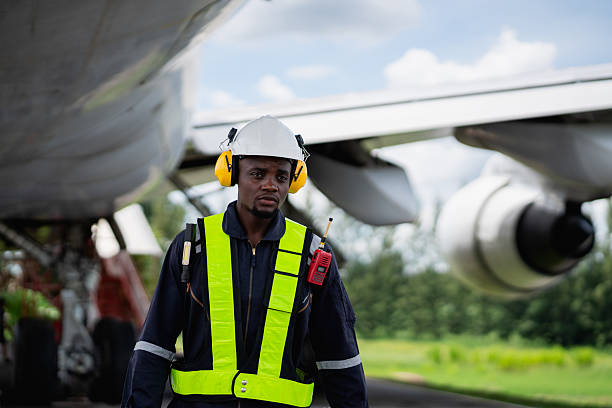
Aviation ground services in Africa cover the activities that support an aircraft, passengers and cargo while an aircraft is on the ground. These services begin before an aircraft arrives and continue until it departs for its next destination.
Ground services can include passenger handling, baggage processing, aircraft marshalling, ramp operations, cargo handling, aircraft cleaning, catering support, load control and the use of ground support equipment.
These activities may not always be visible to passengers, but they are essential to safe and efficient aircraft turnarounds. IATA describes ground handling as an integral part of airline operations and identifies safety, on-time performance and labour availability among the sector’s ongoing challenges. (IATA)
What Aviation Ground Services Include
The exact services available depend on the airport, airline and ground handling provider, but common activities include:
- Passenger check-in and boarding support
- Baggage handling and transfer
- Aircraft marshalling
- Ramp handling
- Aircraft loading and unloading
- Cargo and mail handling
- Aircraft cleaning
- Catering coordination
- Ground power and other aircraft servicing
- Load control and flight operations support
- Ground support equipment operation
- Passenger assistance and special handling
IATA’s ground handling standards cover passenger, cargo and mail handling, load control, ground support equipment management, safety and training. (IATA)
Why Ground Handling Affects Aircraft Turnaround
An aircraft turnaround involves many activities taking place within a relatively short period.
After an aircraft arrives, passengers need to disembark, baggage and cargo must be unloaded, the aircraft may require cleaning and servicing, and new passengers and cargo have to be prepared for departure.
These activities need to be coordinated rather than performed independently. A delay in one activity can affect the departure time.
For example, if baggage loading is delayed while passengers are already waiting to board, the aircraft may not be ready to leave even though other turnaround tasks have been completed.
This is why ground handling performance is closely connected to airline punctuality and airport efficiency.
Ground Support Equipment Is Essential
Ground support equipment, commonly called GSE, provides much of the physical support required around an aircraft.
Depending on the operation, equipment can include:
- Baggage tractors
- Belt loaders
- Pushback tractors
- Ground power units
- Passenger stairs
- Catering vehicles
- Water and lavatory service vehicles
- Cargo loaders
- Aircraft tugs
Equipment availability and condition matter because ground teams cannot complete certain tasks efficiently without the appropriate machinery.
IATA notes that GSE plays a critical role in aircraft servicing and that equipment design affects safety, operational efficiency and working conditions for ground staff. (IATA)
Workforce Remains a Major Ground Services Issue
Ground handling is highly dependent on trained personnel. Ramp agents, baggage handlers, load controllers, passenger service agents, equipment operators and supervisors all have specific responsibilities.
African airports can face difficulties recruiting, training and retaining sufficient numbers of qualified workers, particularly as traffic grows.
Training is also important because employees work around aircraft, vehicles, heavy equipment and passengers in busy environments.
IATA identifies labour shortages as one of the current ground operations challenges and promotes standardised procedures and training to improve safety and efficiency. (IATA)
Safety Has to Come Before Speed
Ground operations involve aircraft moving in confined areas while vehicles and personnel operate around them.
Poor communication, inadequate training, fatigue, equipment problems or rushed procedures can increase operational risks.
Standardised procedures help ground handlers maintain consistent practices across different stations. IATA’s IGOM and Airport Handling Manual provide internationally recognised frameworks covering various ground handling activities. (IATA)
The IATA Safety Audit for Ground Operations, or ISAGO, is another industry mechanism used to assess ground handling safety systems and processes. IATA reported that the programme covered more than 230 ground handling service providers across 441 accredited stations at more than 250 airports as of May 2026. (IATA)
Baggage and Cargo Need Reliable Handling
Passenger baggage is one of the most visible parts of ground services. Bags have to be accepted, screened, sorted, transported to the aircraft and loaded correctly.
Cargo follows a different process but also depends on coordinated handling between warehouses, airlines, freight forwarders, customs authorities and ramp teams.
A breakdown in baggage or cargo handling can cause missed connections, delivery delays or aircraft turnaround problems.
Digital tracking and better information sharing can help ground teams know where baggage, cargo and other operational resources are at different stages of the process.
Digital Technology Is Changing Ground Services
African airports are gradually adopting technologies that can improve ground operations.
These can include:
- Digital turnaround management
- Baggage tracking
- GSE tracking
- Electronic operational documentation
- Automated data exchange
- Equipment monitoring
- Artificial intelligence applications
- Enhanced GSE with anti-collision technology
IATA has identified fragmented data, manual processes and delayed information as barriers to efficient ground handling and is pushing greater standardisation and digitalisation. (IATA)
Technology, however, does not eliminate the need for skilled personnel. Ground teams still need to interpret information, coordinate activities and respond when something goes wrong.
The Shift Towards Cleaner Ground Operations
Ground support equipment is also becoming part of airport sustainability programmes.
Electric GSE can reduce local emissions and noise compared with conventional equipment, although airports need suitable charging infrastructure and operational planning before large-scale adoption.
IATA reported in 2026 that electric GSE can reduce turnaround emissions by approximately 35% to 52%, depending on the equipment mix and electricity source. (IATA)
For African airports, the transition may therefore depend on factors such as electricity reliability, equipment costs, maintenance capability and the age of existing GSE fleets.
How Travo.ng Can Support Aviation Ground Services
Travo.ng is not a specialist ground handling company and should not be confused with airport operators or companies directly responsible for ramp, baggage or aircraft servicing.
Its role can instead support the travel and logistics activities surrounding aviation operations.
For example, when airline personnel, aviation contractors, business travellers or project teams need to move between airports and other locations, Travo.ng can assist with travel bookings, airport transfers, hotel reservations and vehicle hire.
Where a wider logistics requirement exists, delivery and transport coordination can also support movement outside the airport environment.
This can be useful for organisations coordinating staff across cities such as Lagos, Abuja, Port Harcourt or other Nigerian destinations where flights and local transportation need to be arranged together.
Ground Services Need Better Coordination
The performance of aviation ground services depends on several organisations working together. Airlines, airports, ground handlers, cargo operators, security teams and other service providers need clear responsibilities and reliable communication.
African airports can strengthen operations by investing in properly maintained GSE, workforce development, standardised procedures, digital systems and stronger safety management.
IATA’s current ground operations programme emphasises standardisation, safety, modern GSE and digitalisation as important elements of more resilient ground handling. (IATA)
As African aviation activity develops, reliable ground services will remain essential to keeping aircraft moving safely and efficiently. Improvements on the ground can support better turnarounds, more dependable baggage and cargo handling, and a smoother experience for passengers and airlines.
