


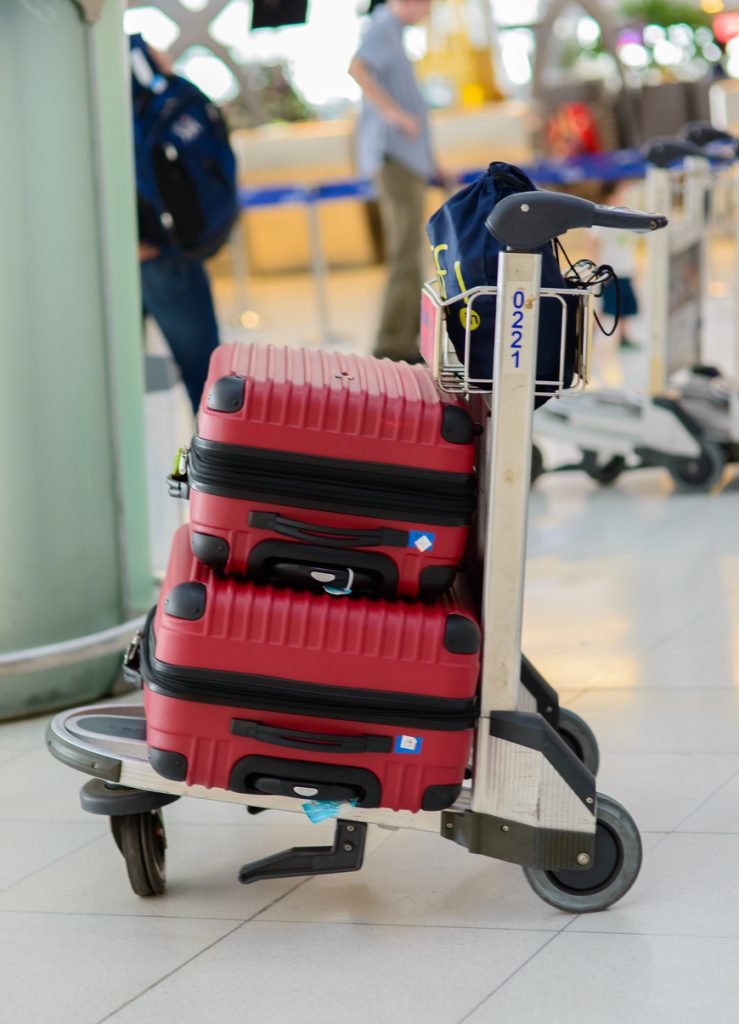
Landing in London with three large suitcases, a cabin bag and a backpack sounds manageable when you are packing at home. It feels very different when you are standing at Heathrow Airport trying to move all of them at once.
For Ghanaians travelling to London for university, work, family visits or relocation, heavy luggage can become a problem before the trip has even properly started. You may have airline baggage limits, excess-baggage charges and the question of how you will get everything from the airport to your accommodation.
The good news is that you do not necessarily have to carry every belonging through the airport.
A practical solution for Ghanaians landing in London with heavy luggage is to separate what you need immediately from what can be transported separately. You can then arrange your airport transfer around the luggage you are physically carrying while sending additional belongings through an appropriate delivery service.
Why heavy luggage becomes a problem after landing in London
The challenge is not simply the weight of the bags.
It is everything that happens around them.
After a long flight from Accra to London, you may need to:
- Complete immigration procedures
- Collect checked baggage
- Move through the airport
- Find your driver or transport
- Load your bags into a vehicle
- Travel through London traffic
- Find your accommodation
- Carry the bags inside
Now imagine doing that with several oversized suitcases.
It becomes even more difficult if you are travelling alone, arriving late at night or travelling to accommodation outside central London.
This is why luggage planning should be part of your travel arrangements rather than something you figure out after landing.
Should you pay for extra airline baggage or send some luggage separately?
There is no universal answer.
You need to compare the airline’s excess baggage cost with the cost of transporting additional belongings separately.
For example, suppose you are relocating to London and your airline allowance covers two checked bags, but you have another suitcase containing clothes, shoes and personal belongings.
You have two broad options:
Option 1: Pay the airline to carry the additional suitcase.
Option 2: Arrange separate luggage delivery and travel with only the bags you actually need at the airport.
The better option depends on the suitcase’s weight, dimensions, destination, delivery timeframe and the airline’s baggage charges.
The important thing is to make the comparison before travelling.
Waiting until check-in to discover that your extra suitcase will cost more than expected leaves you with very little room to find another solution.
What should you carry with you to London?
If you are sending some belongings separately, be selective about what stays with you.
Your cabin baggage should contain items that you would need immediately or would be difficult to replace.
These may include:
- Passport and travel documents
- University or employment documents
- Phone and laptop
- Chargers
- Essential medication where applicable
- Important personal documents
- A change of clothes
- Basic toiletries
- Valuable personal items
Additional clothes, shoes, books and less urgent belongings may be suitable for separate delivery, depending on the carrier’s rules.
The principle is simple: do not make your entire arrival dependent on a separately delivered suitcase.
A practical luggage strategy for students moving from Ghana to London
Consider a student travelling from Accra to London for a September university intake.
Instead of trying to take every possession on the flight, the student could divide their belongings into three groups.
Group 1: Keep with you
These are your essentials — passport, documents, electronics, medication and things you need immediately.
Group 2: Check in on the flight
Use your airline baggage allowance for the clothing and belongings you need during the first few days.
Group 3: Send separately
Additional clothes, shoes, books and other non-urgent possessions can potentially be transported separately.
This approach can make the airport experience much easier.
It also gives you more flexibility when deciding whether paying for additional airline baggage is worthwhile.
Heathrow is easier when you are not carrying your entire life
Heathrow is a major international airport, and navigating it with heavy luggage can be tiring even when you know where you are going.
For a first-time visitor to London, there is another issue: transportation.
You may have to travel from Heathrow to an address in areas such as Stratford, Croydon, Wembley, Greenwich or another part of London.
If you have several heavy suitcases, your choice of vehicle matters.
A vehicle that comfortably accommodates one or two passengers with normal luggage may not be suitable for a group carrying multiple large suitcases.
That is why your luggage quantity should be communicated when arranging an airport pickup.
Book the airport transfer based on your actual luggage
One of the most avoidable mistakes is booking an airport transfer based only on the number of passengers.
The number and size of bags matter too.
For example:
Two passengers + two suitcases each is very different from:
Two passengers + four large suitcases + two cabin bags.
If you are travelling as a family, student group or couple relocating to London, tell the transport provider how much luggage you expect to have.
Travo.ng can help coordinate airport pickup and transport arrangements so your journey from the airport can be planned around your actual travel requirements.
That is much better than landing first and discovering that your vehicle cannot comfortably accommodate your luggage.
What if your accommodation is far from Heathrow?
Not every traveller is staying close to Heathrow.
You may be travelling from the airport to:
- A university residence
- A private student accommodation
- A rented apartment
- A family home
- A hotel
- Temporary accommodation
The further you have to travel, the more important it becomes to plan your airport transfer properly.
London traffic can also make an airport journey considerably longer than the distance on a map suggests.
A trip that looks straightforward geographically can take much longer during busy periods.
If you are carrying several heavy suitcases, standing around waiting for another vehicle or trying to figure out public transport after a long international flight is rarely an attractive option.
What luggage can you send separately?
The exact items permitted depend on the delivery provider and applicable international shipping and UK import rules.
However, travellers commonly consider sending non-urgent personal belongings such as:
- Clothes
- Shoes
- Books
- Personal accessories
- Some household belongings
Before shipping anything internationally, check the provider’s prohibited and restricted-items list.
Pay particular attention to food, liquids, batteries, aerosols, medicines and other items that may be subject to restrictions.
Do not assume that an item is automatically acceptable because another traveller has taken it into the UK before.
Be careful with food from Ghana
For Ghanaians moving to London, food can be one of the biggest areas of confusion.
It is understandable to want to bring familiar ingredients and food products from home. However, UK rules can apply to food, animal products, plant products and other goods entering the country.
The fact that something is commonly carried by travellers does not automatically mean every form or quantity is permitted.
Before putting food into a separately shipped suitcase, check the current UK requirements and the delivery provider’s restrictions.
When in doubt, ask before shipping.
How to protect your belongings during delivery
If you decide to send some luggage separately, packing properly matters.
Start by checking the suitcase itself.
Do not use luggage with a broken wheel, damaged handle or unreliable zip.
Then:
- Weigh the suitcase.
Do not estimate the weight by lifting it. - Create an inventory.
Make a simple list of the major items inside. - Take photographs.
Photograph the contents and the closed suitcase before collection. - Protect fragile items.
Use suitable protective packaging rather than leaving breakable items loose. - Label the shipment correctly.
Follow the provider’s instructions for names, addresses and shipment references. - Keep your tracking details.
Save the shipment reference somewhere you can access easily.
These simple steps can make it much easier to identify your belongings and follow up if there is a problem.
How much does luggage delivery to London cost?
The cost depends on the details of the shipment.
A provider may consider:
- Weight
- Dimensions
- Number of suitcases
- Collection location
- London delivery address
- Delivery speed
- International transportation requirements
- Customs-related considerations
For this reason, a generic “price per suitcase” is not always useful.
A 15 kg suitcase is a different shipment from a 30 kg suitcase, and delivering to a specific London postcode may involve different arrangements from another destination.
When requesting a quote, provide the actual weight and dimensions rather than simply saying, “I have one big suitcase.”
Compare the complete cost, not just the headline price
Suppose you are deciding between paying for additional baggage and sending a suitcase separately.
Do not compare only:
Airline fee vs courier quote.
Consider the entire journey.
For airline baggage, look at the additional baggage charge and how much luggage you will have to manage at the airport.
For separate delivery, ask what the quotation includes.
For example:
- Collection
- International transportation
- Delivery
- Tracking
- Customs-related handling
- Additional charges, if any
A service that appears slightly more expensive initially may offer better overall value if it provides collection from your location and delivery directly to your destination.
What happens if your luggage arrives after you?
This is one of the most important things to consider before sending anything.
International luggage delivery can be affected by transportation schedules, customs processing, weekends, public holidays and final-mile delivery arrangements.
Therefore, do not send everything you own and assume it will arrive exactly when you do.
Instead, carry enough essentials to manage if the separately transported luggage takes longer than expected.
If you are moving to London for university, for example, make sure you have enough clothing and personal necessities with you for the first few days.
Your UK address needs to be ready for delivery
If you are sending luggage to student accommodation, confirm that the residence accepts large deliveries.
Ask:
- Can reception receive large luggage?
- Do they accept deliveries before check-in?
- Does someone need to sign?
- Is there a designated parcel room?
- Are there specific delivery hours?
This is particularly important when your luggage is arriving before you.
You do not want a suitcase reaching London only to discover that your accommodation cannot accept it yet.
What first-time travellers should never put in a shipped suitcase
There are some belongings you should think twice about sending through international luggage delivery.
Your passport and essential travel documents should stay with you.
The same applies to irreplaceable documents, large amounts of cash and other highly valuable personal items.
Also check restrictions before shipping:
- Flammable materials
- Certain liquids
- Aerosols
- Perishable products
- Restricted food
- Batteries
- Certain medicines
- Sharp objects
- Other prohibited goods
The exact rules depend on the shipping provider and applicable regulations, so always confirm before collection.
A better way to prepare for your London arrival
If you know you will be travelling with heavy luggage, plan the journey in this order:
First, determine what you genuinely need on the flight.
Separate essential items from belongings that can wait.
Next, check your airline baggage allowance.
Know exactly how many bags and how much weight your ticket permits.
Then compare your options.
Find out whether additional airline baggage or separate luggage delivery makes more financial and practical sense.
Finally, arrange your airport transfer.
Tell the transport provider how many passengers and bags you will have.
This gives you a complete plan instead of treating luggage, flights and airport transportation as separate problems.
How Travo.ng can help with your London travel arrangements
For Ghanaians travelling to London, especially students, families and people relocating, the journey involves more than simply booking a flight.
You may need help coordinating luggage delivery, airport pickup, accommodation and onward transportation.
Travo.ng provides travel and logistics solutions that can help travellers organise these different requirements. Depending on your needs, services can include luggage and delivery arrangements, airport pickups, travel bookings, hotel reservations and transport coordination.
The key is to arrange these services before you leave rather than trying to solve everything after landing.
A simple checklist before flying to London
Before leaving Ghana, check that you have:
- Confirmed your airline baggage allowance
- Weighed every large suitcase
- Decided which belongings need to travel with you
- Identified items that can be delivered separately
- Checked restrictions on anything you plan to ship
- Prepared an inventory of shipped belongings
- Confirmed your London delivery address
- Checked whether your accommodation accepts large deliveries
- Saved your shipment tracking information
- Arranged an airport pickup if required
- Told the driver how much luggage you will have
- Kept your passport and essential documents with you
Making your London arrival easier
Heavy luggage does not have to turn your first few hours in London into a struggle.
The smartest approach is to plan the entire journey before you fly. Decide what needs to be with you, what can be transported separately and how you will get from the airport to your accommodation.
For Ghanaians landing in London, especially those travelling for the first time, separating luggage delivery from airport transportation can make the arrival much more manageable.
Instead of focusing only on finding the cheapest way to move your bags, look for a solution that gives you a clear process, appropriate handling, useful tracking and delivery arrangements that fit your travel plans.
With proper preparation and the right logistics support, you can step out of the airport with the luggage you actually need — rather than struggling to move everything you own at once.
