


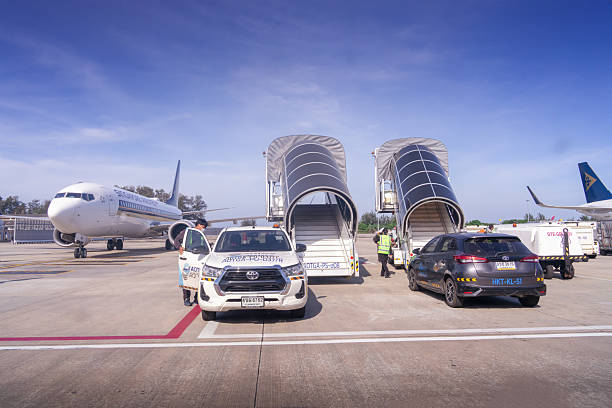
Ramp handling is one of the busiest parts of airport operations. It covers the activities carried out around an aircraft while it is parked, including baggage and cargo loading, aircraft servicing, pushback, ground power, passenger movement and the positioning of ground support equipment.
Across Africa, ramp operations can face challenges involving equipment, infrastructure, staffing, safety procedures and coordination. These problems can extend aircraft turnaround times and contribute to flight delays. Recent industry reporting continues to identify ageing equipment, uneven infrastructure and limited handling capacity as challenges at some African airports. (Aviation Pros)
Common Ramp Handling Challenges
One of the biggest issues is limited or ageing ground support equipment. Ramp teams rely on equipment such as baggage tractors, belt loaders, aircraft tugs, ground power units, passenger stairs and cargo loaders.
When equipment is unavailable or breaks down, several activities can be delayed at once. Maintenance and access to spare parts can also be difficult where specialised equipment has to be imported.
Ramp congestion is another concern. Limited apron space can make it harder to position aircraft and move service vehicles safely, particularly during busy periods.
Staff and Training Challenges
Ramp handling requires trained personnel who understand aircraft safety zones, equipment operation, loading procedures and communication requirements.
A shortage of experienced staff can put additional pressure on existing teams. High staff turnover can also make consistent training and standard operating procedures more difficult to maintain.
Safety is particularly important because ramp workers operate close to moving aircraft and heavy equipment. IATA identifies ground injuries, aircraft ground damage and loading errors as major ground-operation safety concerns. (IATA)
Equipment Failures and Turnaround Delays
Aircraft turnaround involves many activities that have to happen within a limited window. Baggage unloading, cargo handling, cleaning, catering, fuelling and passenger boarding often depend on different teams working in coordination.
If one service is late, the delay can affect the activities that follow. IATA describes untimely ground handling as a factor that can create a chain reaction across aircraft turnaround operations. (IATA)
For airlines operating several flights from the same aircraft, a delay at one airport can therefore affect later flights on the network.
Loading and Communication Problems
Ramp teams also have to work closely with load control and flight crews.
Incorrect baggage or cargo information, poor communication or loading errors can create operational and safety problems. Accurate weight and balance information is essential before departure.
Digital load-management and reconciliation systems are increasingly being used to reduce manual errors and improve communication between ramp and load-control teams. (IATA)
Weather and Airport Conditions
African airports operate in a wide range of environments, from hot and dusty conditions to heavy tropical rainfall.
Severe weather can affect visibility, ramp movement, baggage handling and aircraft servicing. Standing water, poor apron conditions or strong winds can also require additional precautions and slow certain operations.
During periods of heavy traffic, these conditions can place additional pressure on already limited ramp resources.
How African Airports Can Improve Ramp Operations
Improving ramp handling requires more than purchasing new equipment. Airports and ground handlers also need reliable maintenance systems, adequate staffing and consistent safety training.
Useful measures include:
- Replacing unreliable ground support equipment
- Maintaining sufficient spare parts
- Improving ramp space and vehicle routes
- Training and certifying ramp personnel
- Using digital load and baggage systems
- Improving communication between handlers and airlines
- Monitoring equipment availability and utilisation
- Applying consistent safety procedures
Enhanced ground support equipment with features such as proximity sensors is also being promoted by IATA as part of efforts to improve ramp safety and reduce aircraft ground damage. (IATA)
Planning Around Ramp Handling Challenges
Airlines and logistics operators should consider ramp capacity when planning flights, cargo movements and aircraft turnarounds.
Before operating through a particular airport, it can be useful to confirm the available ground handling services, aircraft-compatible equipment, cargo capacity, turnaround requirements and contingency arrangements.
For cargo movements, the planning should also cover what happens after the aircraft arrives. Airport handling is only one stage of the journey, with road transportation, delivery and final destination coordination often following immediately afterwards.
How Travo.ng Supports Travel and Logistics
Specialist ramp handling must be carried out by authorised airport and ground-handling providers. Travo.ng can support the wider travel and logistics requirements connected to airport movements, including airport transfers, transport coordination, delivery arrangements and onward movement.
For businesses operating across African routes, coordinating these ground logistics alongside the flight schedule can help manage the effects of airport delays and operational changes.
