


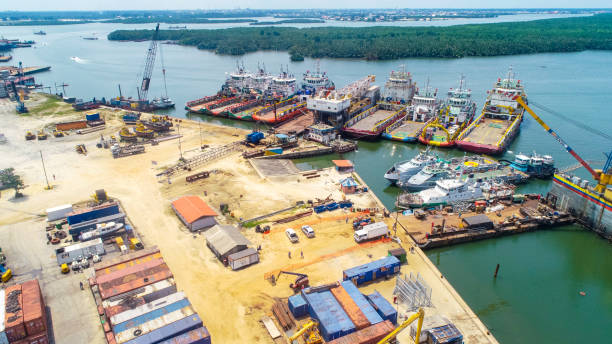
If you’re importing into Nigeria, the “fastest port” doesn’t just depend on the port name—it depends on customs efficiency, truck evacuation speed, congestion levels, and documentation quality. But in real operational terms, some ports consistently clear cargo faster than others.
In 2026, Nigeria’s ports can broadly be ranked based on average clearance speed and congestion pressure.
🥇 Fastest overall: Lekki Deep Sea Port
Lekki Deep Sea Port is currently the fastest and most efficient port for cargo movement in Nigeria.
Why it clears faster:
- Modern deep-sea infrastructure
- Lower congestion compared to Apapa/Tin Can
- Faster truck turnaround due to better road access planning
- High automation and newer cargo handling systems
Typical performance:
- Clearance: 5–10 days in many cases
- Truck turnaround: significantly faster than older Lagos ports
- Lower container backlog risk
👉 In simple terms: if your cargo is time-sensitive and you can route it there, Lekki is the best option.
🥈 Second fastest: Tin Can Island Port (with variability)
Tin Can Island Port is often faster than Apapa in certain cycles, especially for:
- RoRo (vehicle imports)
- containerized goods with clean documentation
- shipments handled by efficient terminals (like PTML operations)
Typical performance:
- Clearance: 3–7 working days (when smooth)
- Can extend during congestion peaks
Why it can still slow down:
- Truck scheduling delays
- Inspection holds
- Port road congestion in Apapa axis
🥉 Third: Apapa Port (most congested)
Apapa Port Complex is Nigeria’s busiest port—but also the most congested.
Reality on the ground:
- High cargo volume (over 50% of Nigeria’s imports pass here)
- Heavy truck traffic and long queues
- Frequent yard congestion
Typical performance:
- Clearance: 5–14+ days depending on congestion and documentation
- Evacuation delays often extend total time
👉 Even when customs is fast, outbound logistics slows everything down.
🧭 Why Lekki is faster than Lagos ports
Lekki’s advantage is structural, not just operational:
- Designed as a modern deep-sea port
- Less dependency on old road networks
- Better cargo flow planning from the start
- Lower congestion buildup
Meanwhile, Apapa and Tin Can are dealing with:
- Legacy infrastructure
- Urban traffic pressure
- High import concentration
- Long-standing container backlog cycles
⚠️ Important truth importers must understand
Even the “fastest port” in Nigeria can slow down if:
- Documents are incomplete
- HS codes are incorrect
- Cargo is flagged for inspection
- Trucks are not pre-booked
- FX or regulatory approvals delay release
So port speed is only 50% of the equation—your preparation is the other 50%.
📊 Quick comparison (real-world experience)
| Port | Speed | Main Advantage | Main Problem |
|---|---|---|---|
| Lekki Port | Fastest | Modern system, low congestion | Still scaling operations |
| Tin Can | Medium-fast | Vehicle & container efficiency | Road + inspection delays |
| Apapa | Slowest | High capacity & connections | Severe congestion |
🚚 Where Travo.ng fits in real logistics flow
Even when cargo clears quickly, operations don’t end at the port.
Delays often happen in:
- airport pickups for import managers
- movement between port and warehouse
- coordination of clearing agents
- hotel arrangements for overseas partners
- urgent transport during release windows
🚖 How Travo.ng supports import operations
Travo.ng helps businesses reduce the real-world delays around port clearance by coordinating:
- Airport pickup for logistics teams and executives
- Transport between Lekki, Apapa, Tin Can, and warehouses
- Hotel booking for import and shipping partners
- Corporate mobility during clearance operations
- Time-sensitive business travel support
Because in Nigeria, even when cargo is cleared fast, movement around the system is what determines real delivery speed.
