


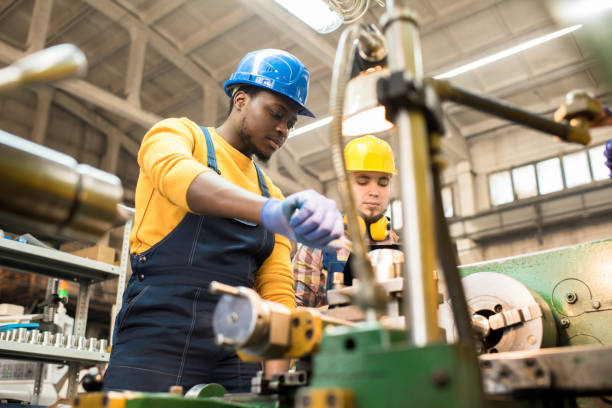
Lagos is one of Nigeria’s major industrial centres, with manufacturing plants, factories, construction companies, logistics operations and engineering businesses relying on skilled maintenance personnel. Industrial mechanic training in Lagos can therefore provide a practical route into careers involving machinery installation, maintenance, troubleshooting and repair.
Unlike automotive mechanics, industrial mechanics work mainly with plant and production equipment. The work can involve pumps, compressors, conveyors, motors, hydraulic systems, pneumatic equipment and mechanical drives.
What Do You Learn During Industrial Mechanic Training?
A practical industrial maintenance programme can cover:
- Mechanical fitting
- Industrial machinery maintenance
- Pumps and compressors
- Bearings and shafts
- Mechanical drives
- Hydraulic systems
- Pneumatic systems
- Engines
- Electrical motor controls
- Sensors
- Preventive maintenance
- Fault diagnosis
- Workshop safety
For example, the Institute for Industrial Technology in Lagos offers industrial maintenance training covering mechanical and electrical systems, hydraulics, pneumatics, sensors and PLCs. Its Safety-Focused Industrial Maintenance Programme combines six months of technical training with four months of industry placement.
Practical Workshop Experience Matters
Industrial maintenance is not something you learn effectively from theory alone. Trainees need to work with actual machinery and learn how technicians identify and correct faults.
A trainee may progress from basic mechanical fitting to:
- Inspecting machinery.
- Checking bearings and mechanical components.
- Aligning shafts and couplings.
- Servicing pumps and compressors.
- Troubleshooting hydraulic systems.
- Diagnosing mechanical breakdowns.
- Performing preventive maintenance.
- Testing machinery after repairs.
This practical experience is important when applying for maintenance jobs because employers need technicians who can work safely around operational equipment.
Why Learn Hydraulics and Pneumatics?
Many industrial machines use hydraulic or pneumatic systems to generate and control movement.
A technician may encounter problems such as:
- Hydraulic pressure loss
- Slow machine movement
- Air leaks
- Damaged hoses
- Faulty valves
- Pump problems
- Contaminated hydraulic fluid
Understanding how to test pressure, inspect components and trace the source of a fault can make a significant difference when maintaining production equipment.
Mechanical Technicians Also Need Electrical Knowledge
Industrial machines frequently combine mechanical and electrical components. A technician may therefore need basic knowledge of motors, sensors, control circuits and automation.
Lagos-based industrial training programmes increasingly combine mechanical maintenance with electrical systems, sensors, PLCs and automation.
This combination can make a technician more versatile when working in factories and processing plants.
How Long Does Industrial Mechanic Training Take?
The duration depends on the programme and your existing qualifications.
Some Lagos programmes provide shorter technical courses, while more comprehensive programmes can last several months or years.
The Institute for Industrial Technology currently offers plant-maintenance programmes of six or 12 months for technicians, operators and other technical workers.
There are also longer vocational routes. A previously published Dangote/VDMA industrial mechanic programme, for example, described a 30-month dual vocational course combining basic engineering, mechanics, electrics, practical training and industrial work experience.
Who Can Apply?
Depending on the programme, industrial mechanic training can be suitable for:
- School leavers
- Apprentices
- Junior technicians
- Mechanical technicians
- Artisans
- Engineering students
- Engineering graduates
- Maintenance workers
- People changing careers into technical work
For example, IIT’s general technical programmes are open to school leavers, graduates and workers, while its Safety-Focused Industrial Maintenance Programme requires at least an OND or equivalent technical background.
Where Can Industrial Mechanics Work?
After gaining sufficient training and practical experience, technicians can work with:
- Manufacturing companies
- Food and beverage factories
- Construction companies
- Logistics businesses
- Industrial plants
- Equipment companies
- Power-related businesses
- Oil and gas service companies
- Agricultural processing companies
- Engineering contractors
Possible job titles include Industrial Mechanic, Mechanical Technician, Maintenance Technician, Plant Maintenance Technician, Mechanical Fitter and Equipment Maintenance Technician.
What Should You Look for Before Enrolling?
Don’t choose a training programme based only on the certificate.
Check whether it provides:
- Real workshop practice
- Industrial machinery
- Mechanical fitting
- Hydraulic and pneumatic training
- Preventive maintenance
- Fault diagnosis
- Electrical fundamentals
- Safety training
- Industry placement
- Experienced instructors
IIT’s programmes, for example, use practical training and industry placements to help participants develop workplace-ready skills.
What Should You Put on Your CV?
If you’re applying for industrial mechanic training or trainee opportunities, highlight your practical abilities.
Include:
- Educational qualifications
- Technical training
- Workshop experience
- Apprenticeship experience
- Mechanical fitting skills
- Machinery you’ve worked on
- Hydraulic experience
- Pneumatic experience
- Welding or fabrication skills
- Maintenance experience
- Tools you can operate
- Relevant technical certifications
If you’ve worked on pumps, compressors, generators, conveyors or production equipment, state the specific machinery.
Applications and CV Submission
Candidates interested in industrial mechanic training and related technical opportunities should prepare an updated CV showing their education, practical experience, technical skills and willingness to learn.
Applications and CVs should be sent to jobs@wigmoretrading.com.
Use Industrial Mechanic Training Application as the email subject and include your phone number, qualifications and relevant technical experience in your CV.
Preparing for the Interview
You may be asked practical questions such as:
- What is preventive maintenance?
- What could cause excessive vibration in rotating machinery?
- How would you investigate a hydraulic pressure problem?
- What is the purpose of a bearing?
- How would you approach a machine that suddenly stops working?
- What safety procedures should be followed before repairing machinery?
- Why is it important to identify the root cause of equipment failure?
If you’re applying for training as a beginner, don’t pretend to have advanced knowledge. Show that you’re technically interested, willing to learn and prepared to follow safety procedures.
Building a Career in Industrial Maintenance
Industrial mechanic training in Lagos can be the starting point for a career in plant maintenance, manufacturing, equipment servicing and industrial engineering support.
As you gain experience, adding skills in hydraulics, pneumatics, electrical controls, PLCs and equipment diagnostics can help you move from entry-level mechanical work into more specialised maintenance roles.
The most valuable training is the one that gives you real machinery experience and teaches you how to diagnose problems safely, rather than simply giving you a certificate.
