


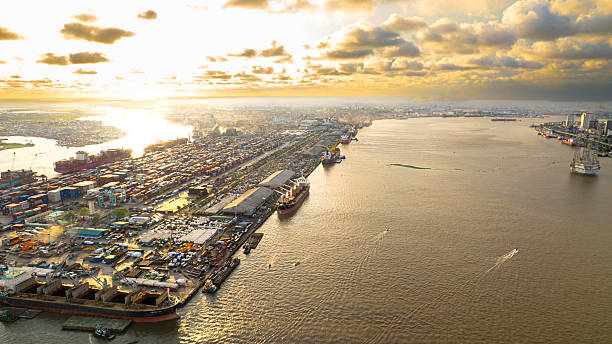
Nigeria port congestion refers to the continuous buildup of ships, containers, and trucks around major seaports—especially in Lagos—where Apapa Port and Tin Can Island Port handle the bulk of the country’s imports. Together, these two ports process more than half of Nigeria’s maritime trade, making them the most critical and most congested gateways in West Africa.
In simple terms, congestion happens because cargo volume consistently exceeds the speed at which ports, roads, and clearance systems can process it.
Why Nigerian ports are still congested
1. Too much cargo concentrated in Lagos
Most imports still land in Apapa and Tin Can, even though Nigeria has multiple ports.
- heavy container inflow
- limited diversion to other regions
- constant vessel arrivals
This concentration creates a pressure point that never fully resets.
2. Road and truck evacuation bottlenecks
Even when cargo is cleared:
- trucks struggle to enter port access roads
- long queues form outside terminals
- evacuation speed becomes slower than discharge speed
So containers stay longer than necessary inside port areas.
3. Limited port infrastructure vs growing demand
Apapa and Tin Can were expanded over time, but cargo growth has outpaced capacity.
- yard space fills quickly
- berths get occupied frequently
- container stacking becomes inefficient
Historically, Tin Can was even built in the 1970s to reduce congestion at Apapa, showing how long this issue has existed.
4. Inefficiencies in cargo clearance processes
Congestion is not only physical—it is also administrative:
- documentation delays
- inspection queues
- overlapping regulatory checks
- inconsistent processing speed across terminals
This slows down cargo exit even when ships are already discharged.
5. High dependence on Lagos ports
More than half of Nigeria’s maritime trade flows through the Lagos port complex alone.
That means:
- Apapa + Tin Can = national pressure points
- every delay multiplies across the economy
What congestion actually looks like on ground
Port congestion in Nigeria is not just “busy ports”—it shows up as:
- ships waiting at anchorage before berthing
- containers piling up inside terminals
- trucks lining major access roads
- delayed cargo release after clearance
- rising demurrage and storage charges
A key consequence is that cargo movement becomes slower than cargo arrival, creating a backlog cycle.
The real economic impact of port congestion
1. Higher import costs
Delays increase:
- demurrage fees
- storage charges
- trucking and haulage costs
2. Inflation pressure
Since most imported goods pass through these ports:
- delays increase landed cost
- higher costs move into retail prices
- consumers pay more
3. Supply chain instability
Businesses face:
- unpredictable delivery timelines
- inconsistent inventory planning
- disrupted production schedules
4. Revenue and trade losses
Studies estimate Nigeria loses billions annually due to port inefficiencies and congestion-related delays.
Why the problem keeps repeating
Even with reforms, congestion persists because:
- infrastructure upgrades lag behind trade growth
- road evacuation remains a weak link
- Lagos continues to dominate import activity
- operational coordination across agencies is complex
- alternative ports are still developing or underutilized
What is being done to reduce congestion
1. New port development
Projects like Lekki Deep Sea Port are designed to:
- handle larger vessels
- reduce pressure on Apapa and Tin Can
- improve cargo flow efficiency
2. Digital clearance systems
More automation is being introduced to:
- reduce paperwork delays
- improve tracking
- speed up customs processing
3. Truck call-up and scheduling systems
These aim to:
- reduce road-side gridlock
- control truck entry into ports
- improve evacuation planning
Where Travo.ng fits in real logistics operations
Port congestion doesn’t end at the gate—it affects movement across the city
Even after cargo clears, businesses still deal with:
- airport pickup for import managers and clearing agents
- movement between ports, warehouses, and business locations
- hotel arrangements for international logistics partners
- urgent transport coordination during clearance windows
- time-sensitive business travel tied to shipments
How Travo.ng supports logistics flow
Travo.ng helps businesses operate around port congestion by coordinating:
- airport pickup and executive transport services
- logistics movement between ports and warehouses
- hotel booking for visiting suppliers and partners
- structured transport for import and clearing teams
- time-sensitive mobility planning during cargo operations
While congestion slows cargo movement, Travo.ng focuses on keeping people, coordination, and operational movement efficient across the supply chain.
